- Home
- Technology and AI
- LeanTaaS uses LookDeep acquisi ...


The integration of strategic expansion into Ambient Intelligence
LeanTaaS, a healthcare technology provider, is moving its iQueue platform from the traditional capacity management role in hospitals to ambient intelligence. The system uses computer vision to monitor patient rooms, turning live physical signals into actionable operational workflows. At the heart of this approach is iQueue for Virtual Care, which employs AI-powered monitoring to identify subtle room events that are not captured in standard EHRs or logged at an appropriate time, such as patient falls, moving without assistance, and hours spent inactive.
Strategic acquisition of LookDeep Health
LeanTaaS recently made its second purchase in a two-month series of deals, acquiring LookDeep Health to help drive this initiative. In addition to integrating the solutions on a third-party basis, LeanTaaS has thoughtfully acquired LookDeep to bring its peer-reviewed vision AI, open platform compatibility, and virtual care capabilities native to iQueue. The evolution is “the central nervous system of the hospital, computer vision being the sensory input to inform intelligent decisions in the operation of the hospital, says founder and CEO Mohan Giridharadas.
Intelligent Workflow & Clinical Impact
It is a closed-loop system that is able to respond to environmental conditions, understand their operational meanings, coordinate responses, and learn from results. iQueue turns room events into prioritized tasks, eliminating extra alarms on the care team. Signals are sent to a virtual observation team (VOT), which evaluates the situation and contacts the patient remotely or calls on bedside personnel according to hospital protocols. All clinical decisions are made by human clinicians, and AI does the contextual analysis and routing. LookDeep’s open architecture design lets health systems avoid vendor lock-in with existing in-room cameras. Senior Vice President of Ambient Intelligence, Narinder Singh, stresses that the technology is meant to help ease the burden of overworked clinical staff through live monitoring. In fact, deployments have shown impressive clinical results, including over a 70% reduction in patient falls, double the nursing contact time, an 80% reduction in medication errors, and a tripling of cost savings over traditional virtual sitting models.
Expanded Virtual Care Suite and Future Roadmap
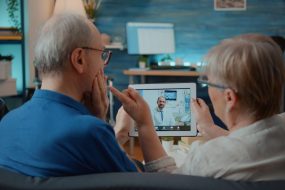
The new virtual care suite includes three main services: Virtual Observation for AI-assisted monitoring and incident escalation, Virtual Nursing for supporting admissions, patient rounding, education, and preparing for discharge, and Virtual Medicine to seamlessly connect patients with remote physicians and specialists. Moving forward, LeanTaaS will leverage the ambient vision capabilities throughout the rest of its product portfolio in inpatient flow, operating rooms, and infusion centers. “Raw data is only useful if it’s directly influencing what’s going to happen next,” says Giridharadas. LeanTaaS aspires to stand out from the generic foundation AI models by relying on a knowledge base developed over a decade and a half and containing tens of thousands of knowledge nodes that are specific to the location. iQueue opens the door between data collection and seamless, coordinated implementation, continuously improving the clinical-to-clinical-to-clinical patient experience across the healthcare enterprise.
LeanTaaS is expanding its healthcare technology capabilities through the acquisition of LookDeep, a move designed to bring ambient intelligence into its iQueue platform. The development reflects the growing demand for smarter, data-driven tools that can help healthcare organizations improve operations and make better use of limited resources.
LeanTaaS Uses LookDeep Acquisition to Extend iQueue Into Ambient Intelligence
The integration of LookDeep technology could enable LeanTaaS to capture and interpret information from healthcare environments with less manual effort. Ambient intelligence has the potential to provide real-time insights into workflows, capacity, and operational activity, helping organizations identify opportunities for improvement.
Through iQueue, LeanTaaS already focuses on optimizing valuable healthcare resources such as operating rooms, infusion centers, and inpatient capacity. Adding ambient intelligence capabilities may give healthcare teams a more detailed understanding of how these resources are being used throughout the day.
The acquisition also highlights a broader shift toward intelligent healthcare operations. Rather than relying only on historical reports and manual data entry, organizations are increasingly looking for systems that can continuously collect insights and support faster decision-making.
For LeanTaaS customers, the combination of iQueue and LookDeep technology could create a more connected approach to operational management. Healthcare leaders may be able to access clearer information about workflow patterns while reducing the administrative burden placed on clinical and operational teams.
As hospitals continue to face pressure to improve efficiency and patient access, LeanTaaS is positioning ambient intelligence as another tool for modernizing healthcare operations. The expanded iQueue platform could help organizations move toward more responsive, efficient, and data-informed care delivery.
How LeanTaaS Is Expanding iQueue With Ambient Intelligence
The acquisition of LookDeep represents an important step in the growth strategy of LeanTaaS and its iQueue platform. Healthcare organizations are under increasing pressure to improve patient access, reduce delays, and make better use of expensive clinical resources. Ambient intelligence can help address these challenges by collecting operational information directly from the care environment and transforming it into useful insights.
By extending iQueue with new ambient intelligence capabilities, LeanTaaS may help hospitals gain a clearer picture of how spaces, staff, and resources are being used. Traditional operational systems often depend on manual updates, which can create gaps between what is happening in real time and what is recorded in a system. Intelligent sensing and automated data collection can help reduce these gaps.
The expanded platform could also support better decision-making across operating rooms, infusion centers, and inpatient care. Healthcare leaders need accurate information to identify bottlenecks and respond quickly when patient demand or resource availability changes. Real-time operational insights can make it easier to improve scheduling and capacity planning.